Code 128

A compact, versatile linear symbology widely used for inventory, shipping, product identification and internal tracking.
Learn Code 128 →Practical explanations of barcode symbologies, printing, scanning and identification technologies used in manufacturing, warehousing, logistics, healthcare and retail.
Each guide explains what the barcode stores, where it is commonly used, its strengths and limitations, and practical considerations for printing and scanning.
A compact, versatile linear symbology widely used for inventory, shipping, product identification and internal tracking.
Learn Code 128 →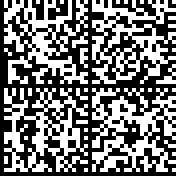
A compact two-dimensional symbol designed to hold more data in a small area and remain useful on very small items.
Learn Data Matrix →
A long-established industrial barcode still encountered in manufacturing, identification and legacy applications.
Learn Code 39 →
A GS1 implementation of Code 128 used to carry standardized application data in supply-chain applications.
Learn GS1-128 →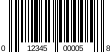
The familiar retail point-of-sale symbol used to identify consumer trade items in North America.
Learn UPC-A →
A widely recognized two-dimensional barcode used for URLs, consumer engagement and many identification workflows.
Learn QR Code →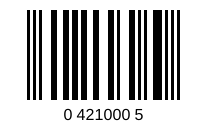
A compressed UPC format used on small retail packages.
Learn UPC-E →
A compact retail symbol that carries a GTIN-8.
Learn EAN-8 →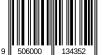
The widely used international retail symbol carrying a GTIN-13.
Learn EAN-13 →
A distribution barcode commonly used for GTIN-14 on cartons and cases.
Learn ITF-14 →
A numeric-only industrial barcode that encodes digits in pairs.
Learn I2of5 →
A legacy linear code still found in specialized workflows.
Learn Codabar →
A high-capacity stacked barcode used in IDs, transport and documents.
Learn PDF417 →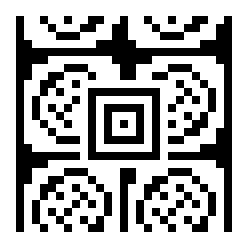
A compact matrix symbol recognized by its central bullseye.
Learn Aztec →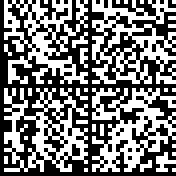
Compact GS1 element-string encoding for traceability and small items.
Learn GS1 DataMatrix →
GS1 use of QR Code, distinct from ordinary QR and Digital Link QR.
Learn GS1 QR Code →Good implementation requires more than choosing a symbology. Size, clear space, data integrity, print quality, media and scanner technology all contribute to reliable performance.
These guides connect barcode standards to real production decisions—from printer resolution and label materials to scanner selection and verification.
What ISO-based verification measures and why “it scans” is not enough.
PRINTINGBarcode Print QualityDiagnose contrast, print growth, speed, darkness and printhead problems.
PRINTING203 vs. 300 vs. 600 DPIChoose printhead resolution based on barcode size and label requirements.
PRINTINGDirect Thermal vs. Thermal TransferChoose the printing method based on label life and environment.
SCANNINGScanner TechnologyCompare laser, linear imaging and 2D area imaging.
DATACheck DigitsUnderstand identifier checksums and barcode check characters.
COMPARECode 39 vs. Code 128Density, compatibility and the better choice for a new application.
COMPAREQR Code vs. Data MatrixCompare consumer, industrial and small-item 2D applications.
COMPAREGS1-128 vs. GS1 DataMatrixChoose a GS1 carrier based on space, scanners and supply-chain requirements.
Move beyond definitions with step-by-step diagnosis, pre-production checklists and an interactive barcode selection tool.
Work through data, geometry, print quality and scanner causes in a useful order.
TROUBLESHOOTScans on One Scanner, Not AnotherUnderstand scanner capability, settings and marginal print quality.
CHECKLISTBarcode Label Design ChecklistPreflight data, size, quiet zones, materials, placement and testing.
PRINTING10 Common Printing MistakesAvoid the recurring problems that cause failed scans and weak symbols.
PRODUCTIONTest Before ProductionQualify the complete label, printer and scanner workflow before rollout.
PRINTINGHow Ribbon Affects QualityUnderstand ribbon/media compatibility, transfer and durability.
SELECTIONChoose a SymbologyStart with requirements, data, space and scanner infrastructure.
INTERACTIVE TOOLBarcode Selection WizardAnswer four questions to create a shortlist worth investigating.
Future guides will connect symbologies to actual workflows so readers can understand why one barcode is chosen over another.
Work-in-process, asset identification, serialized parts, traceability and production labels.
Locations, cartons, pallets, shipping labels, receiving and inventory movement.
Product identification, traceability, unit-of-use marking and compact 2D data carriers.
Barcode Education is an independent educational resource focused on practical barcode knowledge. The goal is to explain standards and technologies in clear language while connecting them to printing, scanning and real industrial applications.