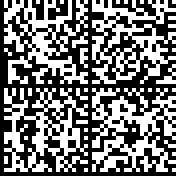
What is Data Matrix?
Data Matrix is a two-dimensional matrix barcode that encodes data as a pattern of light and dark modules. Most readers recognize the symbol by its characteristic solid “L” finder pattern along two adjacent sides, with alternating modules along the opposite sides.
Because data is arranged in two dimensions rather than one long row, Data Matrix can carry useful amounts of information in a compact footprint. This makes it especially useful for small labels and direct marking on parts.
How does it work?
The symbol is built from modules placed in a defined grid. Finder and timing patterns help an imager determine the symbol's orientation and module spacing. Encoded data and error-correction information occupy the remaining region.
Modern industrial implementations generally use Data Matrix ECC 200, which uses Reed–Solomon error correction. That error correction helps a reader recover data when part of the symbol is damaged or obscured, within the limits of the symbol and damage involved.
Where is Data Matrix used?
Data Matrix is often selected when physical space is limited, when a product needs a unique serial identifier, or when a mark must survive industrial handling. Common examples include electronic components, medical products, automotive and aerospace parts, instruments, nameplates and small manufactured items.
The technology is also well suited to direct part marking methods such as laser marking or dot peen when the application requires permanent identification rather than an applied label.
Advantages
- Compact footprint: It can encode useful data in much less horizontal space than a linear barcode.
- Error correction: ECC 200 provides resilience against limited symbol damage.
- Omnidirectional imaging: 2D imagers can decode the symbol regardless of the label's rotational orientation.
- Direct part marking: It is widely used where the symbol is permanently marked into or onto a component.
- Structured industry use: GS1 DataMatrix can carry standardized GS1 identifiers and attributes.
Limitations
- It requires a 2D imager rather than a legacy laser-only scanner.
- Very small modules demand appropriate printer or marking resolution and careful process control.
- High-density symbols may become difficult to print reliably on rough, reflective or low-contrast surfaces.
- A general Data Matrix symbol and a GS1 DataMatrix symbol are not automatically interchangeable; application standards matter.
Data Matrix vs. GS1 DataMatrix
Data Matrix describes the barcode symbology. GS1 DataMatrix uses that symbology under GS1 rules so data elements have standardized meanings. GS1 Application Identifiers can indicate items such as a GTIN, batch or lot number, serial number and expiration date.
This distinction matters in regulated and supply-chain applications because the receiving system must know not only how to decode the modules but how to interpret the resulting data.
Printing and marking considerations
When printing Data Matrix on thermal label media, module size, printer resolution, contrast and surface quality are especially important. For direct part marking, the marking process must create enough geometric and optical contrast for the imager to identify individual modules and finder patterns.
Increasing data usually increases the required number of modules. If the physical symbol size is fixed, additional modules make each module smaller, which may eventually exceed the capability of the printer, marking method or scanner. Good design balances data length, symbol size and the real production process.
Data Matrix vs. Code 128
| Consideration | Code 128 | Data Matrix |
|---|---|---|
| Type | 1D linear | 2D matrix |
| Space efficiency | Excellent for short-to-moderate linear data | Excellent when label area is constrained |
| Scanner | 1D or 2D-capable scanner | 2D imager required |
| Damage tolerance | Limited compared with 2D error-corrected symbols | ECC 200 error correction |
| Typical use | Inventory, locations, shipping, internal IDs | Small items, serialization, traceability, direct marking |
Frequently asked questions
Is Data Matrix the same as QR Code?
No. Both are 2D matrix symbologies, but they use different symbol structures, encoding rules and finder patterns.
Can a phone scan Data Matrix?
Many modern camera systems can decode Data Matrix when software support is available, but industrial applications normally use dedicated 2D imagers selected for the required symbol size, distance, surface and production speed.
Why use Data Matrix on a tiny part?
Because its two-dimensional structure allows data to be packed into a small area. This can be more practical than making a linear barcode extremely wide or reducing its bar width beyond the print or scan system's capabilities.